Life is full of surprising..

The Elephant Capture and Translocation Programme was established in 1974 by the Department of Wildlife and National Parks (DWNP).
In 1990, the Elephant Conservation Centre at Kuala Gandah was set up as a permanent base for the Elephant Capture and Translocation Unit. The only one of its kind in Malaysia, it is dedicated to the protection and translocation of the wild elephant.
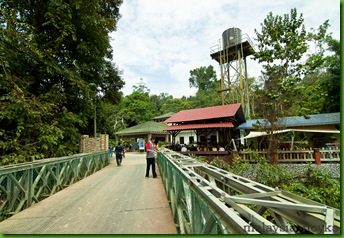


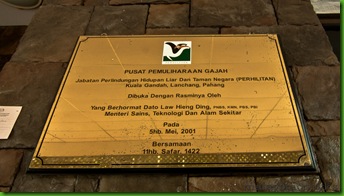
Objectives of Centre:
Overall:
- The conservation of the elephant and its habitat through sustainable management, in tandem with the aspiration of the nation.
Immediate:
-
Ensuring the protection and management of the elephant and its habitat.
-
Enhancing the public's knowledge, awareness and support on the importance of the elephant conservation.
-
Managing the Elephant Conservation Centre as a centre for research, education, as well as economic and eco-tourism activities.
Daily routine at the Kuala Gandah Elephant Conservation Centre.
| Time | Activity | Description |
| 8.00am | Breakfast | Elephants are fed a breakfast consisting of pellets and concentrates. |
| 9.30 to 10.30am | Training | Elephants are trained to: - Learn basis commands such as sit and stay.
- Obey specific commands for translocation work.
- Break bad habits.
|
| 10.30am | In the enclosure | Elephants are free to roam the enclosure. |
| 11.30 to 12pm | Lunch | Visitors can assist staff to feed the elephants a lunch of fruits such as papaya, bananas, watermelon, carrots and sugarcane. |
| 12 to 2pm | In the enclosure | Elephants are again free to roam in the enclosure. |
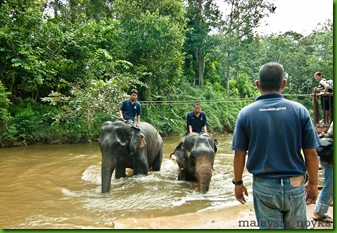
| 2pm | Bath and Free Ride | Elephants bathe and swim in the river, under staff supervision. The elephants also provide riding to visitors with limited admission (with yellow sticker). |
| 3pm | Stalled | Elephants return to their stalls and are chained for the night. |
| 3.15pm | Dinner | Elephants are fed a dinner of grass, banana plants and fruits such as sugarcane and papaya. |
Distribution of the Asian Elephant:
-
The Asian Elephant is estimated to number between 35,000-53,000 animals in the wild.
-
In the Peninsula Malaysia, the population is estimated between 800 to 1,000 animals.
The Real Facts of Elephant:
-
An elephant usually sleeps for around 4 hours a day (and even then they wake every 15 minutes to check for danger !)
-
Working elephants have been known to haul logs weighing over 4 tonnes.
-
Elephant can live up to 69 years of age. The oldest elephant ever recorded died at the age of 82, his name was 'Raja' and he lived in captivity in Sri Lanka.
-
Elephants mourn their dead, covering the dead body with branches and grass or stopping at an area where a relative has died, as if remembering a lost family member.
-
Mother elephants look after their young longer than any other animal except humans. Mother have a lot of help from the rest of the herd, with each member taking part in bringing up the babies.
Open to Public
Daily from 12pm to 4.45 pm
- Advance bookings required for groups
- Follow staff instructions at all times
- Bring a change of clothes (restroom and showers available)
- No accommodation available at the sanctuary

Getting There
- From Kuala Lumpur proceed to the Karak Highway and then the East Coast Expressway
- Exit at the Lanchang toll and come to a t-junction
- Take a right turn and follow the signboards to Kuala Gandah
- The tarmac road narrows over the last few kilometers, so drive slow
- An Orang Asli settlement is at the end of the road just before reaching the sanctuary
Visitors are not charged a fee; instead a donation is sought for the Elephant Trust Fund. Conservation funds are always in short supply, so please be generous with your support.
For those that want to go on the elephant rides – Call up KGECC (Tel: 09- 2790391) for reservation a few days before your trip (especially if it’s a public holidays or school holidays), KGECC gives out special yellow stickers for this, (there is a limitation to the number of yellow sticker given out per day), for the regular red stickers it’s ‘lawatan sahaja, tidak dibenarkan mengikut aktiviti menunggang dan mandi bersama gajah’ – visitation only, not allowed to participate in riding and bathing activities with the elephant.


Pack your meals if you are fussy about food because the choices are limited. There are some warongs at the sanctuary serving roti and some simple meals, drinks, air kelapa muda are available.
BATHING
Visitors can join the elephants as they bathe and swim in the river under staff supervision.



HAND FEEDING ACTIVITIES BY VISITORS:
Visitors can participate in feeding the elephants, their lunch of banana, carrot, papaya etc.


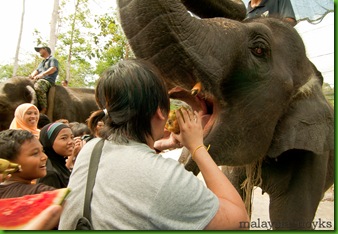

The elephant just opened its mouth and waiting to be feed by visitors... don't worry the fruits were prepared by the staffs.


-- The clever young elephant know how to take the food from visitor.

-- Kids sure like elephant..


-- Looking at me??he..
ELEPHANT RIDES (Limit to 120 persons/day, register early to get the yellow sticker)
Visitors are invited to ride an elephant around the centre in a natural way without basket.


 -- All visitors are having fun with elephants..


-- Elephants riding among the grounds..
Others Activities:
(1) Although no accommodation available at the sanctuary, but visitors can bring their food / drinks and gathering with friends and families.

(2) During my trip, I saw local boys were playing water-polo with foreign visitors in the river at NECC.


It was fun !! I want to play with them but unfortunately I don't know how to swim and my camera was not waterproof...


FUN !!!!
| 
--GOAL!!!

|
Oh Wait!!! NooooOO !!! Surprised!!
You know what! This goal almost hits me down to the river from platform!! The innocence young boys keep saying: "Sorry, sorry, sorry, Abang (Mr.)..." I just laugh and say I'm fine.. Thanks for these young boys bring me excitement and surprising... Hopes I be young again to have fun with them... Watched them play is one of the most excitement moment in my life, life is full of surprising...Really..
There is something I would like to say from this trip is: "Thank You for these innocent young boys..., May God bless them forever happy and freedom like Peter Pan".
Having fun BOYS !!
Thank you to the elephants too...
For further information regarding this fantastic place, please contact:
National Elephant Conservation Centre (NECC)
Department of Wildlife and National Parks (DWNP/PERHILITAN)
Kuala Gandah, 28500 Lanchang
Pahang Darul Makmur
Tel: 09-2790391
Notice:
The Department of Wildlife and National Parks (DWNP) Peninsular Malaysia would like to clarify its stand regarding www.myelephants.org, a website featuring the National Elephant Conservation Centre at Kuala Gandah, Lanchang, Pahang, which comes under the direct jurisdiction of the DWNP.
The website, as well as the bank account for donations, have been set up without any affiliation with or consent from the DWNP.
The DWNP is fully responsible for the management of elephants in Peninsular Malaysia and thus has the necessary resources to support all elephant conservation related activities. However, if any members of the public who wish to donate for te conservation of elephants in Malaysia or at this centre should send the donations directly to the DWNP.
Please be advised that the DWNP does not receive funds from the public via third party bank accounts.
Have Fun!!


